One five-foot rigid-PVC part instead of two — molded in a single shot
Application brief · Building products · Rigid PVC · Large-part molding · Automation
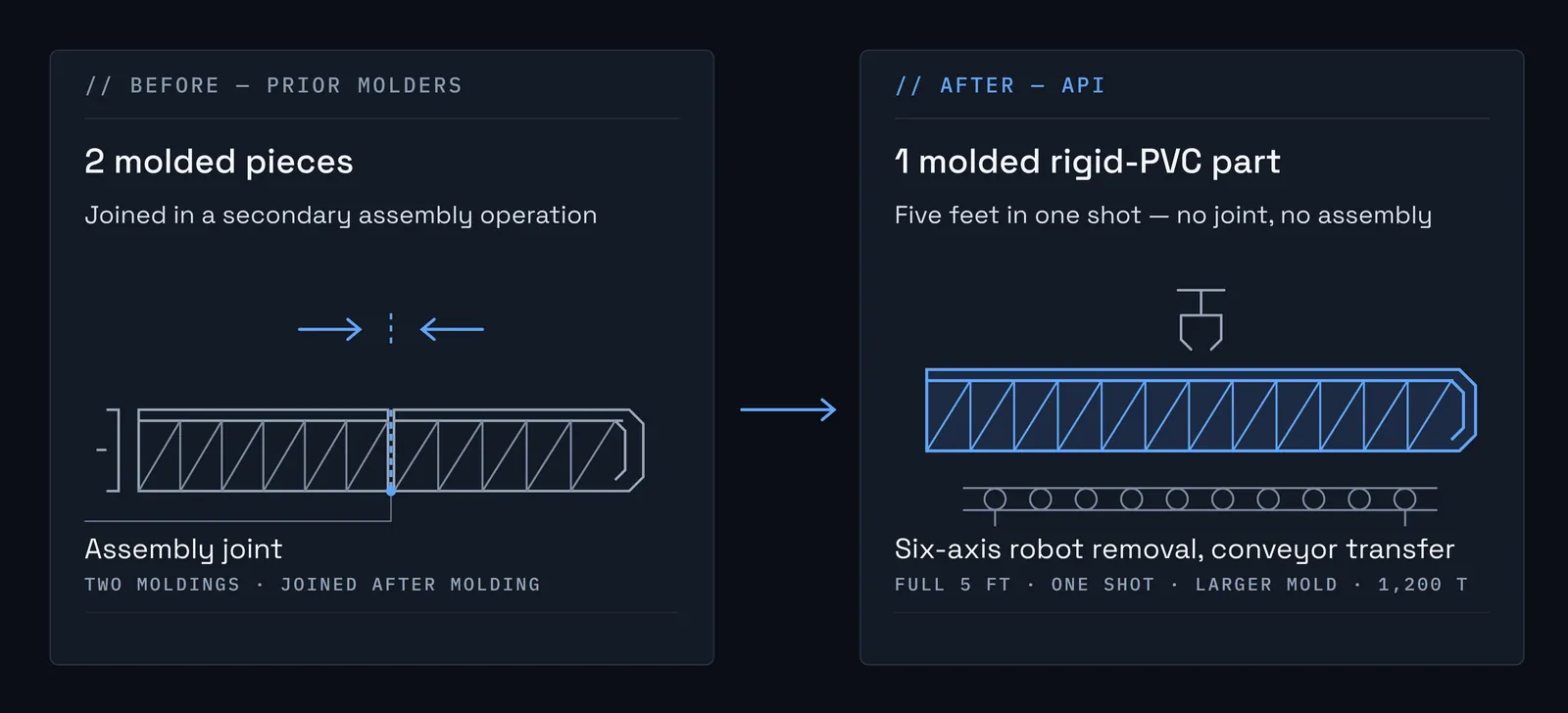
A national building-products manufacturer needed a molder that would run rigid PVC — a material most shops decline — on an exterior-grade frame section 5 feet long, 5 inches wide, and 3/8 inch tall, with a 0.093-inch wall and ribs at two-thirds of that: under two pounds of material spread over a 60-inch part, held to ±1/8 inch of straightness. Their incumbent molders produced it as an assembly: two shorter moldings joined in a secondary operation — two parts to mold and handle, a joint to control and inspect, and an assembly step standing between the press and the box on every unit, every shift.
The challenge: a large part in an unforgiving resin
PVC's processing window is narrow. Not hot enough and the part will not fill; slightly too hot, or too long in the barrel, and the resin degrades — releasing hydrochloric acid that attacks molding equipment and tooling. Small PVC parts are demanding enough. Scale the part up to five feet, with a 0.093-inch wall, ribs thinner still, and ±1/8 inch of straightness over 60 inches, and the margin for error shrinks further. That is why most molders either decline large PVC components or break them into smaller pieces that have to be joined afterward.
What API changed: one part, one mold, one cell
- Part consolidation. API's engineers redesigned the component as a single rigid-PVC part — the full five feet in one shot, from a larger mold. No joint to inspect, no second piece to mold, store, and marry up: the assembly step disappeared from the process rather than being automated.
- Tooling built for the part. The production mold was engineered and built in API's own tool room, where it is maintained for the life of the program — so part design, mold design, and process development stayed in one set of hands.
- A press and cell sized for it. The part runs on a 1,200-ton Haitian press. A six-axis robot removes each five-foot part from the mold and places it on a conveyor to inspection and pack-out, so a long, thin-walled part is handled the same way every cycle.
Large PVC components at API
Large rigid-PVC moldings are a specialty few custom molders take on. API's molding fleet runs to 1,200 tons and the tool room builds molds sized to match, so PVC parts that other shops split into several pieces can often be molded whole. For OEMs, that means:
- Fewer pieces, fewer joints — consolidated designs take out assembly steps, fixtures, and the inspection that comes with every joint
- Long, thin-walled geometry held straight — five-foot parts with sub-0.1-inch walls and ±1/8-inch straightness are in production today
- Exterior-grade building products at production volume — rigid PVC's weather and chemical resistance, molded on a floor that runs three shifts
- Design-for-molding review before tooling — API's engineers review wall, rib, and consolidation opportunities on your CAD, print, or sample
- Robotic handling built in — six-axis removal and conveyor transfer for parts too large to handle consistently by hand
- Twenty-five years of PVC experience — molded at API alongside engineering resins, with tooling, molding, and automation under one roof
Program snapshot
| Industry | Building products (exterior-grade) |
| Material | Rigid PVC — molded at API for 25 years |
| Part | 60 × 5 × 3/8 in · 0.093 in wall · ribs at two-thirds wall · under 2 lb · ±1/8 in straightness over 5 ft |
| Tooling | Single-piece production mold — designed, built, and maintained in the API tool room |
| Press and cell | 1,200-ton Haitian · six-axis robot removal · conveyor transfer to inspection and pack-out |
What it delivered
- One part number where there were two — simpler bill of materials, simpler inventory, and no joint to qualify or inspect
- A secondary operation removed — the assembly station, its handling, and its scrap stream are gone from the process, not just moved
- Repeatable handling, shift after shift — robotic removal and conveyor transfer give every part the same path from mold to box, in a plant that runs three shifts
- One supplier for part, mold, and production — design engineering, the tool room, and the molding floor sit in the same 100,000 sq ft building
Where this applies: large or long rigid-PVC components, especially parts now made as several pieces and joined; other corrosive or flame-retardant resins, including programs moving from FR-ABS or FR-polycarbonate to PVC; and high-volume building-products programs that need robotic handling or secondary operations designed out. See rigid PVC molding and assembly and automation.
Have a large PVC part, or an assembly that should be one molding? Send us the CAD, print, or a sample.
Engineered thermoplastics replace metal — lower cost, better performance
Cost pressure without any loosening of performance standards has pushed manufacturers in medical and dental, electronics, automotive, aerospace, and defense to replace metal and other traditional materials with engineered thermoplastics. API's role is to make that conversion work: understanding the part's function, selecting the resin, designing for manufacturability, building the mold, and proving the part.
What the conversion delivers
- Performance: lower weight; corrosion, chemical, and UV resistance without secondary coatings; electrical insulation where needed
- Sensory: noise and vibration damping; thermal stability in the hand
- Manufacturing: complex geometry molded in one piece replaces several machined or stamped parts and the fixtures, fasteners, and labor that joined them; shorter cycle times; recyclable regrind
- Appearance: molded-in color, texture, and in-mold decoration eliminate painting and plating
Metal-loaded compounds of up to 94% metal content extend the approach to parts that need mass, shielding, or thermal conductivity. The resin guide lists the metal-replacement candidates we run most often.
Self-service RFID security unlocking saves staff time and cuts theft
A leader in the asset-protection market needed a self-service checkout system that would let library patrons unlock secured media packaging themselves. Security cases deterred theft, but unlocking them at the desk was slow and labor-intensive — and library traffic was climbing.
The challenge
Unsecured, discs walked out the door. Secured, every checkout required staff to unlock each case by hand. The customer needed a system patrons could operate unattended, that checked the item out and released the lock in one motion, and that made swapping or removing the disc impossible.
Design and engineering
API engineers worked with the customer's team from the earliest stage through part design, material selection, testing, tool design, molding, and assembly — the same concurrent process we apply to every program.
The result
- An unattended self-service station that unlocks media and records the loan simultaneously
- A redesigned case that checks out the disc itself, closing the swap-and-switch loophole
- A security design that protects the collection without slowing the patron
API's security-packaging designs have since been used across retail and institutional markets to deter theft without hurting the point-of-sale experience.
Automation in molding and assembly reduces cost and lead time
Robotics at the press and in the assembly cell are how API stays cost-competitive with molders anywhere. Custom and off-the-shelf robots remove parts and runners, transport components between operations, load inserts, and perform secondary operations — eliminating handling errors, cutting scrap, and shortening cycle and lead times.
Levels of automation applied at API
- Resin handling and feeding
- Part, runner, and sprue picking and separation
- Over-mold transfer for the second shot and insert loading for insert molding
- Part placement, orientation, sorting, and stacking for secondary operations
- On-line and off-line assembly, inspection, and packaging in robotic cells
What changes
- Lower piece cost from shorter cycles and less labor
- Higher consistency and less variation and waste
- Faster time to market from compressed cycle and lead times
Automation is scoped to the program: a simple sprue picker for a short run, a full six-axis cell for high volume. See assembly and automation.
Why offshore tooling is not always the cheaper option
Buyers who chase the lowest tooling quote abroad often discover that the landed cost — and the calendar — look very different from the proposal. API has rebuilt enough compromised offshore tools to know the pattern.
Hidden costs of offshore sourcing
- Design approval by shipping samples back and forth delays launch
- Freighting a tool or parts can add weeks and substantial cost, with damage risk in transit
- Time zones and language slow every engineering change
- Incomplete or non-standard mold designs make the tool hard or impossible to transfer later
- Currency swings and unknown supplier stability add risk no quote captures
What building the tool at API changes
- Mold and parts are designed, built, sampled, and run in the same Long Island building — you can visit the tool while it is being built
- Tools are stored and maintained on site by the people who made them, for the life of the tool
- A short supply chain, aggressive lead times, and robotic automation keep piece prices competitive
- Parts are produced under US regulations in an ISO 9001 Certified facility, using certified and compliant materials as the program requires
- Every quote and invoice is in US dollars, and every design is handled under non-disclosure practice
When overseas capacity is the right answer for a program, we will say so. For most tooling and precision molding, the arithmetic favors a supplier you can drive to.
Related
Have a problem like one of these?
Send a model or a sketch — an API engineer will review it and tell you how we would build it.