Molding capacity built for difficult parts
Autronic Plastics (API) runs a modern, climate-controlled molding floor of twenty injection molding machines spanning 55 to 1,200 tons of clamp force. Five machine brands cover the range: tie-bar-less Engel Victory presses for small and medium parts with large molds or robot access, Haitian Zhafir Zeres electric presses and Haitian Jupiter two-platen presses for flexible mid-range and large-part work, all-electric Toshiba EC and Sumitomo SE-EV presses, and Sodick V-LINE machines in a clean-room cell for tight-tolerance precision components.
Production runs three shifts, 24/5, with weekend capacity available for program ramps. Molds are built and maintained in the tool room down the hall, so a steel change or a repair never has to leave the building.
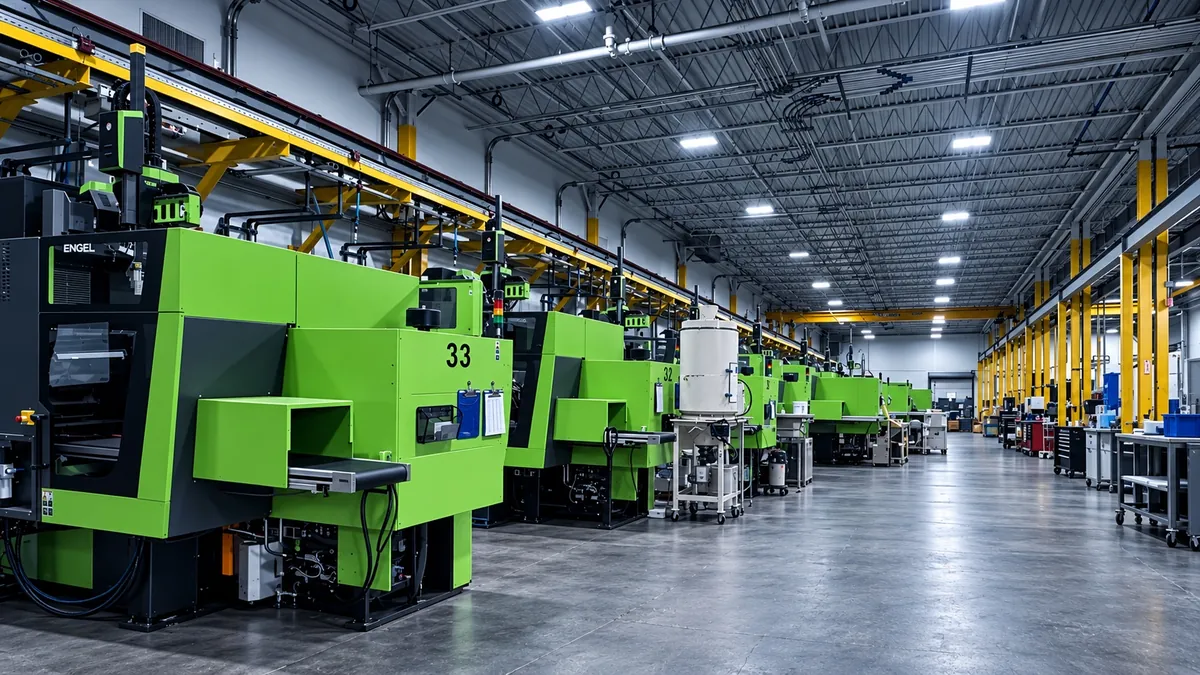
Press list
| Clamp | Machine | Qty | Notes |
|---|---|---|---|
| 55 T | Toshiba EC55 V50 | 1 | All-electric; small precision components |
| 90 T | Engel Victory 90 | 2 | Tie-bar-less; oversized molds and robot access on a small press |
| 100 T | Sodick GL100A and MS100G2 | 2 | V-LINE two-stage plunger injection; clean-room cell; one hybrid, one all-electric |
| 110 T | Toshiba EC110 | 1 | All-electric |
| 130 T | Engel Victory 130 | 2 | Tie-bar-less servo-hydraulic, CC300 control |
| 240 T | Engel Victory 240 | 3 | Tie-bar-less servo-hydraulic, CC300 control |
| 250 T | Toshiba EC250SX | 1 | All-electric |
| 340 T | Engel Victory 340 | 1 | Tie-bar-less servo-hydraulic, CC300 control |
| 350 T | Sumitomo SE315EV | 1 | All-electric |
| 500 T | Sumitomo SE450EV | 1 | All-electric |
| 618 T | Haitian Zhafir Zeres ZE5500 | 2 | Electric clamp, injection, and screw drive with integrated servo-hydraulics for core pulls |
| 731 T | Haitian Zhafir Zeres ZE6500 | 1 | Electric clamp, injection, and screw drive with integrated servo-hydraulics for core pulls |
| 1,200 T | Haitian Jupiter JU10900III | 2 | Two-platen servo-hydraulic clamp for large housings, structural and metal-replacement parts |
Twenty presses in total — 8 Engel, 5 Haitian, 3 Toshiba, 2 Sumitomo, and 2 Sodick — from 55 to 1,200 tons of clamp force, each with a dedicated material bay fed by the central material-handling system.
Every cell can be fitted with six-axis or top-entry robots for part removal, insert loading, degating, and in-cycle assembly. Central material handling, desiccant drying, and closed-loop mold temperature control keep process windows stable from the first qualified shot to the millionth.
Molding processes
Insert molding
Threaded inserts, bushings, terminals, and stamped or machined metal components are loaded by hand or by robot and over-molded in a single cycle, eliminating a secondary pressing or staking operation. Because API also fabricates metal, the insert and the plastic can be engineered together.
Two-shot and over-molding
Two resins in one process add grip, seals, color breaks, or soft-touch surfaces without assembly. API has established chemical-bond pairings (including TPE and TPU onto rigid substrates) and designs the rotary or transfer tooling that two-shot work requires.
Clean-room precision molding
Sodick V-LINE machines in a controlled cell handle small, tight-tolerance components for medical, dental, and electronics programs where contamination control and shot-to-shot repeatability matter more than tonnage.
Engineering and high-performance resins
PEEK, PPS, PEI, PSU, PC, nylons, acetals, high glass-fill compounds, and metal-loaded alloys of up to 94% metal content are routine at API. Our resin guide summarizes the families we run most often. Scientific molding — decoupled fill, pack, and hold with documented process windows — keeps dimensions stable on the materials most shops decline.
Rigid PVC and large PVC components
Rigid PVC (vinyl) is a resin most custom molders turn away. Its processing window is narrow — under-heated it will not fill, and over-heated or held too long in the barrel it degrades, releasing hydrochloric acid that attacks molding equipment and tooling. API has molded PVC alongside engineering resins for decades, and large parts are where that experience shows: with presses to 1,200 tons and molds built in our own tool room, API molds long, thin-walled PVC components in one piece that other shops split into several. PVC programs run on the same automated cells as everything else, with six-axis robotic removal and conveyor transfer. Flame-retardant and other halogenated compounds get the same treatment. For a worked example — a five-foot rigid-PVC assembly consolidated into a single molding — see the PVC application brief.
Tool transfers
Moving an existing mold to API is a managed process, not a leap of faith. Our engineers review the tool design and condition up front, flag compatibility or quality concerns, and recommend fixes before the first sample. The tool room can repair, re-texture, or re-engineer a transferred tool, and the mold is then qualified, documented, and scheduled so there is no gap in your supply.
- Tool condition and design review before the move
- Repairs, hot-runner service, and steel-safe changes in-house
- First-article inspection and documented process setup
- On-site mold storage and preventive maintenance for the life of the tool
Quality in the cycle, not after it
API is ISO 9001 Certified and a UL Certified molder and assembler. Process parameters are validated and recorded for each tool; CMM, optical, and functional inspection follow the control plan your program requires; and first-article and in-process reports are retained electronically. Read more on our quality page.
Who we mold for
API serves OEMs and contract manufacturers in medical and dental, defense and aerospace, lighting and life safety, automotive, security packaging, displays, and industrial and consumer products. Most programs arrive one of three ways: a part another molder could not hold, a new product that needs tooling and production under one roof, or an existing tool that needs a more capable home.
Frequently asked questions
What size parts can Autronic Plastics mold?
With presses from 55 to 1,200 tons, API molds everything from small clean-room precision components to large structural housings. Tie-bar-less Engel presses allow unusually large molds on smaller machines, which widens the range further.
Do you mold engineering resins like PEEK, PPS, and glass-filled nylon?
Yes. High-temperature and high-performance thermoplastics, high glass-fill compounds, and metal-loaded alloys of up to 94% metal content are a core competency, supported by scientific molding and documented process windows.
Do you mold rigid PVC?
Yes. Rigid PVC (vinyl) has been part of API's resin mix for decades, alongside engineering thermoplastics — including large components. API molds five-foot, thin-walled PVC parts in a single shot on presses up to 1,200 tons, with six-axis robotic removal, from molds built and maintained in our own tool room.
Can you take over an existing injection mold?
Yes. API reviews the tool design and condition, repairs or modifies it in our own tool room if needed, then qualifies and documents the process so production continues without a gap.
Where is your molding facility?
All molding, mold construction, metal fabrication, assembly, and shipping happen in our 100,000 sq ft headquarters at 1150 Motor Parkway, Central Islip, NY 11722 on Long Island, about six miles from Long Island MacArthur Airport.
Related
Send us the part other molders declined.
Send a model or a sketch — an API engineer will review it and tell you how we would build it.